
A Guide Through the World of Welding Techniques
Whether you are building a bridge over the Scheldt or assembling a tiny medical instrument, everything depends on the connection. Welding is a discipline in its own right, a balance between heat, material and precision. But not every weld is the same.
In this blog, we dive into the world of joining techniques. We move from heavy-duty methods to microscopic precision, with a special focus on the technology of the future: laser welding.
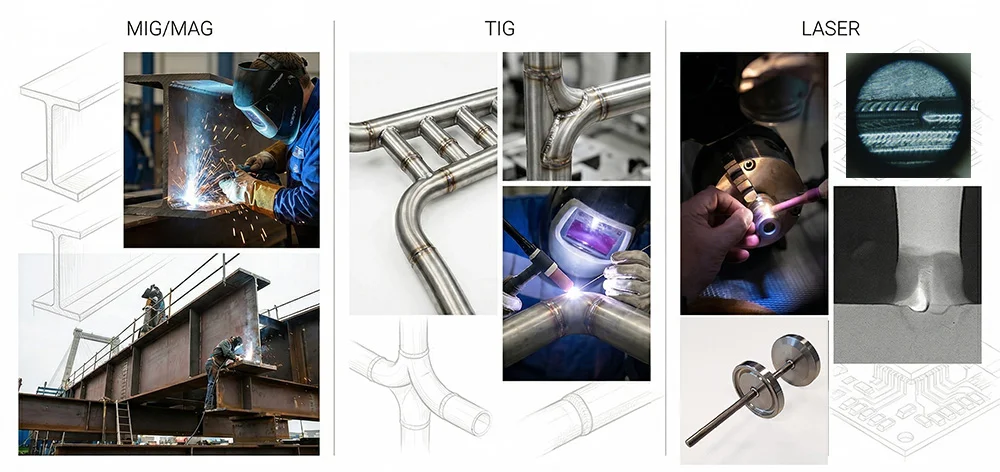
MIG/MAG Welding: The Powerhouses of Construction
When we talk about the “heavy-duty work”, we are talking about MIG/MAG welding (Metal Inert Gas / Metal Active Gas). It is the most commonly used welding method in heavy industry, and for good reason.
- Application: Think of the steel structures of skyscrapers, enormous bridges and shipbuilding.
- How it works: A wire is fed continuously and melts in the electric arc. Because the wire itself acts as the electrode, you can keep welding for long stretches without stopping.
- Characteristics: It is fast and relatively easy to learn, but it introduces a lot of heat into the material. For a bridge, that is not a problem, but for fine, delicate work the distortion is often too great.
TIG Welding: The Aesthete of Industry
If you walk into a factory where high-quality piping for the food or chemical industry is made (pipe fittings), you will almost always see TIG welders (Tungsten Inert Gas).
- Application: High-end industrial installations, thin-walled stainless steel and aluminium.
- How it works: This method uses a non-consumable tungsten electrode. With one hand you control the torch, and with the other you manually add filler material.
- Characteristics: TIG welding is slow, but it produces the cleanest and strongest welds. It is pure craftsmanship. However, the heat input is still considerable, which creates challenges when working with very thin sheets.
Now we come to the specialty we work with every day at Tumag. Where MIG/MAG and TIG stop because the process becomes too coarse or too hot, laser welding begins. In 2026, this technique has become the standard for companies that do not want to compromise on quality and speed.
Laser Welding: Surgical Perfection
Now we come to our own field of expertise. Where traditional methods reach their limits due to heat or scale, laser welding truly stands out. In 2026, this technology has become the gold standard for anyone working in fine mechanics and high-tech assembly.
Why choose laser welding? (SEO: Benefits of laser welding & precision welding)
Laser welding uses a highly concentrated beam of light to melt metals. This offers unique advantages compared to traditional methods:
- Minimal heat input: Because the laser beam is extremely focused, only the required spot is heated. This means no distortion of your workpiece.
- Extreme speed: Laser welding is often 5 to 10 times faster than TIG welding.
- Fine mechanical assemblies: We can weld parts so small they are barely visible to the naked eye. Think of sensors, medical components or complex machine parts.
- Virtually invisible weld seams: The weld is so narrow and deep that post-processing (grinding or polishing) is often no longer necessary.
Application Area: From Repair to High-Tech
In our workshop, we are seeing a shift from mass production to fine mechanical repair and assembly. Has an expensive mould been damaged? With laser welding, we can add material very precisely without damaging the rest of the tool. Need to join two thin sheets made of different metals? The laser handles it.
Whether it is for the aerospace industry, the medical sector or fine mechanics, laser welding offers a level of control that is simply impossible to achieve with a torch.
 |
Laser welding for mould repair and precision work | TumagNeem contact op met Tumag voor advies over matrijzen, stempels en precisietooling. Ons team helpt je graag verder met engineering en productie. |
Which technique do you need?
The choice of a welding technique always depends on your project. Need a steel frame for a warehouse? Grab the MIG torch. Need piping in a brewery? TIG is your best friend.
But if you are looking for a solution for complex assemblies, thin-walled materials or precision repairs where every millimetre counts, then laser welding is the only logical choice.
Want to know more about what laser welding can mean for your specific project? Feel free to contact us for a technical consultation.
Sources for the curious reader:
- a href="https://www.nil.nl" target="_blank" rel="noopener">NIL (Netherlands Institute for Welding Technology) – For in-depth technical knowledge about all welding processes.
- TWI (The Welding Institute) – A global authority in joining technologies.
- Fraunhofer Institute for Laser Technology – For the latest innovations in laser welding (2026 updates).
- BIL – Belgian Institute for Welding Technology: Belgium’s leading reference for research, inspections and advice on welding processes.
Laser welding for mould repair and precision work | TumagNeem contact op met Tumag voor advies over matrijzen, stempels en precisietooling. Ons team helpt je graag verder met engineering en productie. |