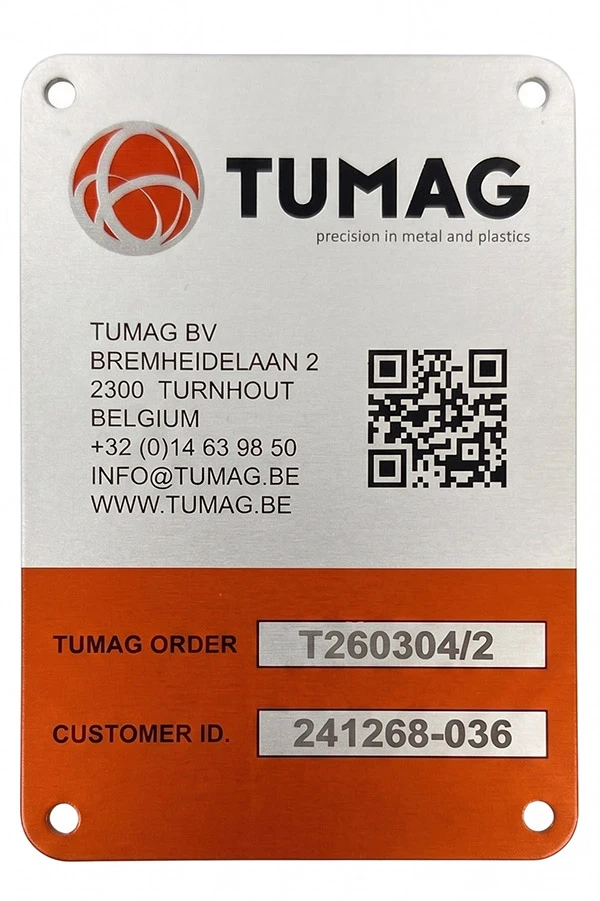
Metal engraving with a fibre laser gives your parts a permanent, traceable identity — from serial numbers to UDI marking. Contactless, wear-resistant and suitable for stainless steel, aluminium, titanium and more.
Give your parts a lasting identity with high-quality fiber laser marking
At Tumag, we combine technical expertise with advanced precision technology. Whether it concerns serial numbers, barcodes or logos, we guarantee a razor-sharp result that withstands the toughest industrial conditions.
- Razor-sharp precision: Durable marking of metal components (such as stainless steel, aluminium, brass and titanium) with our fiber laser.
- Maximum resistance: Resistant to wear, chemicals and extreme stress.
- Integrated service: Seamless connection with our expertise in engineering, precision manufacturing and mould maintenance.
This ensures that your parts are not only produced with the highest precision, but are also immediately provided with permanent identification.
Traceability in the medical and high-tech sectors
In sectors such as the medical industry and the high-tech sector, flawless traceability (UDS/UDI) is not just desirable, but often a legal requirement. Components must be traceable back to their source and specifications at every stage of the chain.
Tumag understands the strict quality requirements of these markets. We have extensive experience in burr-free and corrosion-resistant engraving of medical-grade stainless steel, titanium and special alloys. By laser marking parts directly, you minimise the risk of errors caused by labels coming loose or markings becoming unreadable. Our fiber laser ensures a hygienic, smooth finish that meets the highest standards of quality assurance.
Why choose laser engraving at Tumag?
Unlike stickers or printing, laser engraving is inseparably linked to the material. This is essential throughout the entire lifecycle of a product—from production and assembly to maintenance and recycling.
The main advantages:
- Permanent & wear-resistant: Resistant to chemicals, heat and friction.
- High precision: Even the smallest QR codes and finest details remain perfectly readable.
- Flexibility: Suitable for variable data such as sequential serial numbers.
- Contactless: No mechanical stress on the part, which prevents deformation.
- Efficient: No ink or additional consumables required.
- Visual: Professional and technical appearance
- Reproducible: The digitally controlled process guarantees a consistent and identical result in every production run.
Engraving metal: from steel to aluminium and titanium
We engrave a wide range of metals. Whether it involves engraving metal such as steel, stainless steel, brass, copper or titanium, we guarantee a razor-sharp and lasting contrast. Engraving aluminium, whether anodised or untreated, also delivers a sharp and permanent result. For each alloy, we fine-tune the laser settings so the marking remains legible under the toughest industrial conditions.
Metal engraving fits seamlessly with our core activities such as high-precision production, CNC machining and mould maintenance. This allows us to manufacture your parts and immediately provide them with the necessary identification.


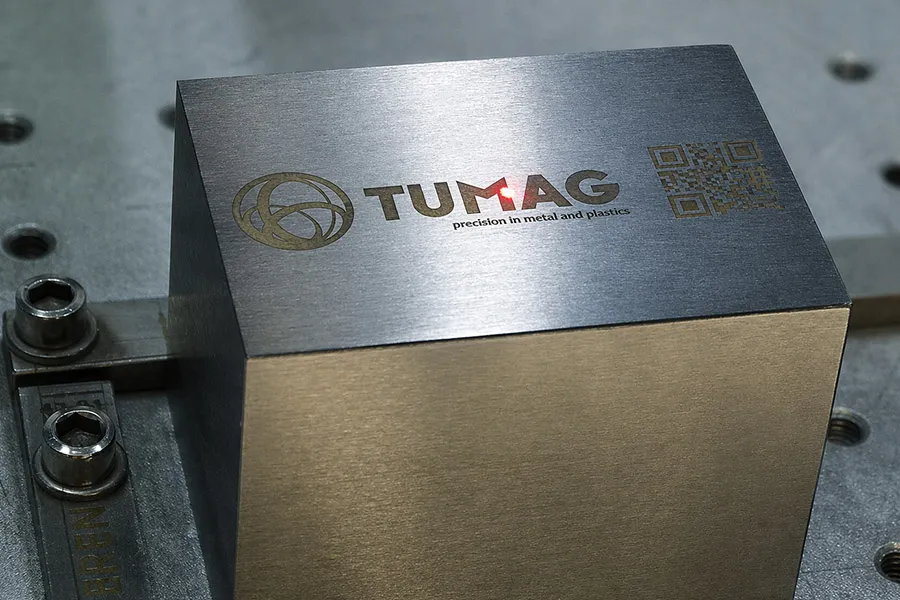
Common applications
- Identification: Serial numbers, batch numbers, article codes and nameplates.
- Digital data: QR codes, barcodes and Data Matrix codes.
- Certification: CE markings and technical symbols.
- Branding: Company logos and type designations on machine parts.
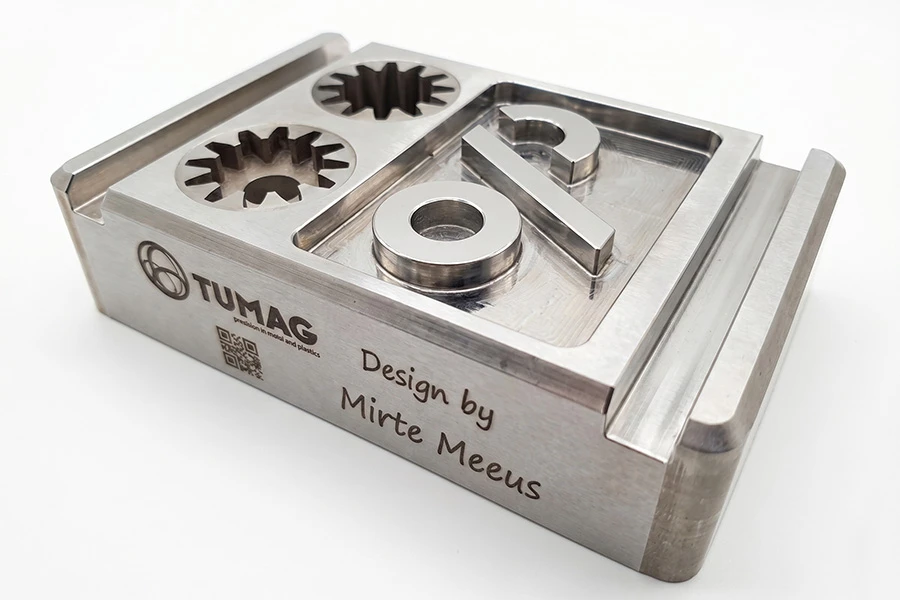
Outsource laser engraving to Tumag?
We handle both single pieces and large series with consistent, high quality. Our specialists are happy to advise you on the best settings for your specific material and application.
Thanks to our in-house expertise, we integrate the engraving process seamlessly into your entire production or maintenance chain.
Frequently asked questions about laser engraving (FAQ)
What is laser engraving?
Laser engraving uses a concentrated laser beam to apply a marking to the surface of a material. The laser processes the metal locally, creating a permanent engraving or marking. Unlike stickers, labels or printing, the information is applied directly to the part.
Tumag uses a fiber laser for this. This type of laser is especially suitable for marking and engraving metals. A fiber laser works quickly, accurately and with a high energy density, allowing even fine details, small text and compact codes to be applied sharply.
This makes fiber laser engraving highly suitable for technical applications where readability, durability and repeatability are important.
What can laser engraving be used for?
Common applications of laser engraving are:
- Serial numbers
- Batch numbers
- Article codes
- Type designations
- Production dates
- Barcodes
- QR codes
- Data Matrix codes
- Logos
- CE markings
- Technical symbols
- Customer-specific texts
By applying this information directly to the part, the identification remains linked to the product itself. This reduces the risk of mix-ups, loss of information or errors in the chain.
Which metals can be engraved?
Metal engraving with a fibre laser works on virtually all industrial metals: untreated steel, stainless steel, aluminium, brass, copper and titanium. Each material responds differently to the laser, which is why the settings are adjusted for each alloy to achieve maximum contrast.
Can aluminium be engraved?
Yes. Aluminium engraving can be done on both untreated and anodised aluminium. On anodised aluminium, it produces a sharp, high-contrast result; on untreated aluminium, it creates a durable, tactile marking that is resistant to wear and chemicals.
Can every laser process all materials?
No, the effectiveness of a laser is determined by the wavelength of the light. Different materials each respond differently to specific wavelengths:
- Fiber lasers (Tumag’s speciality): They have a short wavelength that is absorbed very efficiently by metals. This makes them powerful and extremely precise for steel, stainless steel, aluminium, copper, titanium, brass and various hard plastics.
- CO2 lasers: They have a longer wavelength. Metals often reflect this beam like a mirror. CO2 lasers are ideal for organic materials such as wood, glass and leather.
How deep is a laser engraving?
This depends on your specific requirements. We can vary from a light surface marking (also known as annealing or temper colours, ideal for the medical sector because the surface remains smooth) to a tactile deep engraving for maximum wear resistance, for example on nameplates.
Does a QR code remain scannable after intensive use?
Yes. Because the engraving is in the metal itself, the code remains readable as long as the surface is not extremely heavily damaged. This makes it superior to traditional labels in industrial environments.