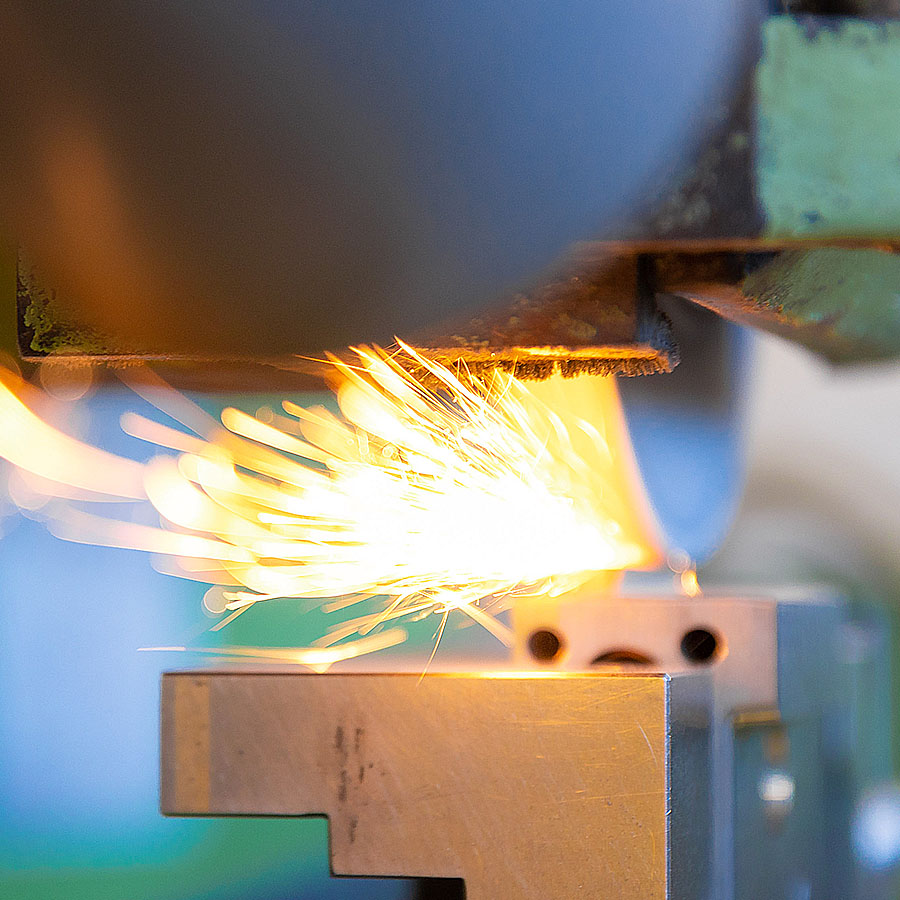
Profile shapes and grooves with micrometre precision
Profile grinding is a chip-removing grinding process used to create complex contours, grooves and profile shapes in metal workpieces. This operation is part of our high-precision production offering and, together with surface grinding, cylindrical grinding and jig grinding, forms Tumag’s complete precision grinding offering. We use profile grinding where parts require tight tolerances and precise geometries, for example in cutting tools, mould components and precision mechanical components.
What is profile grinding?
In most grinding operations, the movement of the machine determines the shape of the result. In profile grinding, the shape is largely incorporated into the grinding wheel itself. The wheel is dressed in advance with the negative of the desired profile and then moves over or along the workpiece, transferring that shape into the material. This creates, in a single operation, a part with a sharply defined geometry, such as a V-shape, a series of teeth, a radius transition or a combination of flat surfaces and radii.
Profile grinding is one of the precision machining processes used in precision mechanics. Depending on the material, the complexity of the profile and the workholding setup, tolerances in the micrometre range are achievable, in favourable cases down to around ±2 µm. Surface quality is also a key strength. For components requiring a roughness below Ra 0.8 µm, for example on mating and sealing surfaces, grinding is generally the preferred method.

Industrial applications of profile grinding
The technique is used where profiles need to be produced accurately, repeatably and in hard materials. Common applications include:
- Cutting dies and punching tools, where the cutting geometry determines the quality of the punched or cut product.
- Mould components and mould parts, where profiles, guides and mating surfaces must fit together with micrometre accuracy.
- Precision components for the high-tech, medical and aerospace sectors, where reliability and repeatability are key.
In many cases, profile grinding is not the only operation, but a finishing or defining step in a longer machining process chain.
Materials for profile grinding
Profile grinding truly comes into its own with hard and hardened materials, precisely where milling and turning reach their limits. Materials we regularly profile grind include:
- Hardened steel and tool steel, the cold-work and hot-work steels used in dies and moulds. These materials are chosen precisely for their hardness and wear resistance, which makes finishing difficult and grinding almost indispensable.
- Stainless steel, which places high demands on machining due to its toughness.
- Carbide, a highly wear-resistant material commonly used in cutting tools and components where tool life is critical.
- Various non-ferrous metals, where precision or a fine profile shape is required.


Profile grinding at Tumag
For components with tight tolerances and complex geometries, we keep the entire process in-house, from preparation through to quality control. Because we master all other machining operations in addition to profile grinding, we can respond effectively to your requirements and smoothly combine processes or align them with each other, always in consultation with you.
Do you have a challenging profile for which you are looking for a reliable partner? Contact us and we will be happy to help you determine the best approach.
Share your profile with us, and we will think along with you.

Frequently asked questions about profile grinding (FAQ)
What is dressing and why is it important in profile grinding?
Dressing is the process of shaping and sharpening the grinding wheel, and it is decisive for the quality of the final result. It consists of two tasks that overlap. During profiling, the wheel is accurately given the geometry required by the workpiece. During sharpening, the abrasive grains are opened up, creating fresh cutting edges and freeing up space for chip evacuation. A properly dressed wheel cuts cool and freely, resulting in low grinding forces and a clean finish. With a single-point diamond dresser or a diamond profile roller, very small internal radii can be achieved, in the range of 0.1 to 0.2 mm. Dressing is carried out regularly, sometimes between workpieces, with rising power consumption or a deteriorating finish indicating that the wheel needs attention again.
Which grinding wheels and abrasives are used in profile grinding?
The most suitable grinding wheel depends strongly on the material being machined. Conventional abrasives include corundum (aluminium oxide) and silicon carbide. They are cost-effective, easy to dress and suitable for a wide range of steel grades. For more demanding work, superabrasives come into play: cubic boron nitride (CBN, also known as Borazon) and diamond. CBN is particularly suitable for hardened steels because it retains its shape and sharpness for a long time. Diamond is the preferred choice for very hard and abrasive materials such as carbide, ceramics and glass. The right combination of abrasive and material results in long tool life, a stable process and consistent quality.
When should you choose profile grinding and when EDM?
Both techniques can handle hardened materials and both achieve high precision, but there are clear differences. EDM works electrically and therefore requires a conductive material, which excludes ceramics and some non-ferrous materials that can be machined by profile grinding. EDM also introduces heat into the surface, resulting in a thin heat-affected layer, whereas a well-cooled grinding process machines the material mechanically and at low temperature. For certain geometries, such as a sharp internal corner profile without a radius, EDM has the advantage. The optimal choice depends on the material, the required shape, the tolerances and the quantity. Because we have both techniques in-house, we can choose the most suitable method for each component.
Is profile grinding suitable for one-off parts or series production?
Both are possible. Profile grinding is suitable for one-off parts and small batches as well as for series production. Especially for prototypes and small batches, the accuracy and repeatability of profile grinding are an advantage, because the shape is repeatably defined by the machine.