
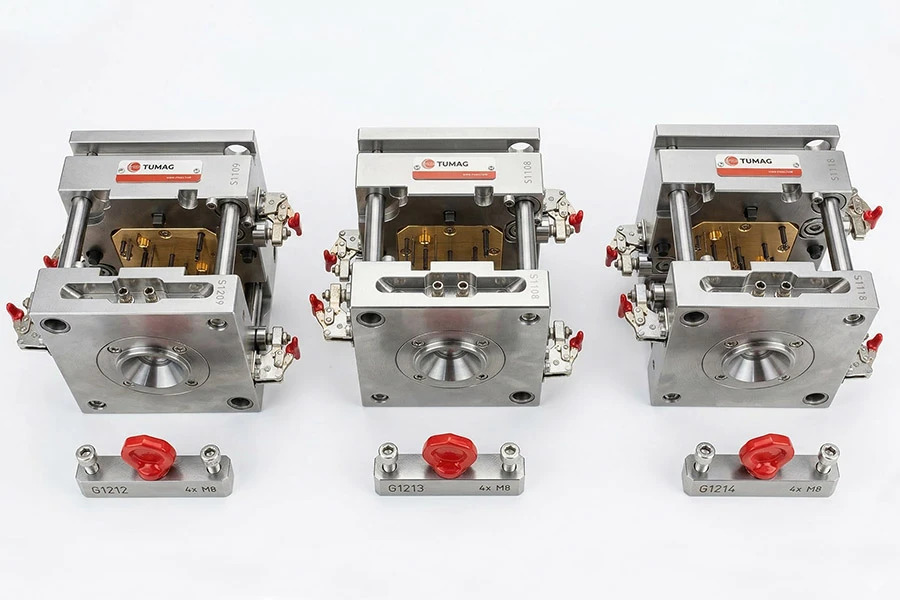
You pay for the insert, not the complete mould block
A traditional injection mould can easily cost €25,000 or more. That is a justifiable investment for tens of thousands of parts, but not when you have a validated prototype and initially need five hundred parts to test the market. FlexMould splits that mould: we own and maintain the universal base block, while you only invest in the product-forming inserts, the cavity and the core. That is the only part that is unique to your product. Compared with a complete injection mould, your start-up costs therefore decrease by 70 to 80 percent.
From 50 pieces onwards, we produce in the final material on our own machines, so small-series injection moulding takes place at the same site in Turnhout. Before the insert goes into production, our engineers assess your design for manufacturability through co-engineering. You can already go through the rules of thumb for an injection-mouldable design yourself.
3D printing, modular mould or complete steel mould: what costs what?
The choice is rarely about technology and almost always about volume. Below one hundred pieces, 3D printing remains cheaper. Above fifty thousand pieces, a complete mould pays for itself through cycle time and multi-cavity production. The zone in between is exactly where most first series get stuck, and where a modular mould closes the gap. The figures behind that choice, including the financial tipping point per volume, are set out in the volume comparison between prototype and mass production.
| Criterion | 3D printing | Modular mould (FlexMould) | Complete steel mould |
| Upfront investment | None | € 5.000 – € 25.000 | € 25.000 – € 200.000 |
| Lead time to first parts | A few days | 4 to 6 weeks | 8 to 16 weeks |
| Cost-effective volume | 1 – approx. 100 pieces | 50 – 10,000 pieces | From approx. 50,000 pieces |
| Material | Printing materials, mechanically different | Standard, engineering and fibre-reinforced plastics | Standard, engineering and fibre-reinforced plastics |
| Surface finish and dimensional stability | Visible layer lines, limited dimensional stability | Identical to series production | Identical to series production |
| Design change | New print | New or modified insert | Modification to the complete mould block |
| Multiple products per mould | Not applicable | One product per insert | Multi-cavity possible |
*The prices shown here are purely intended to indicate the difference between a modular mould and a complete mould. The actual price of a mould depends very much on the complexity and dimensions of the final product.
What is a FlexMould insert?
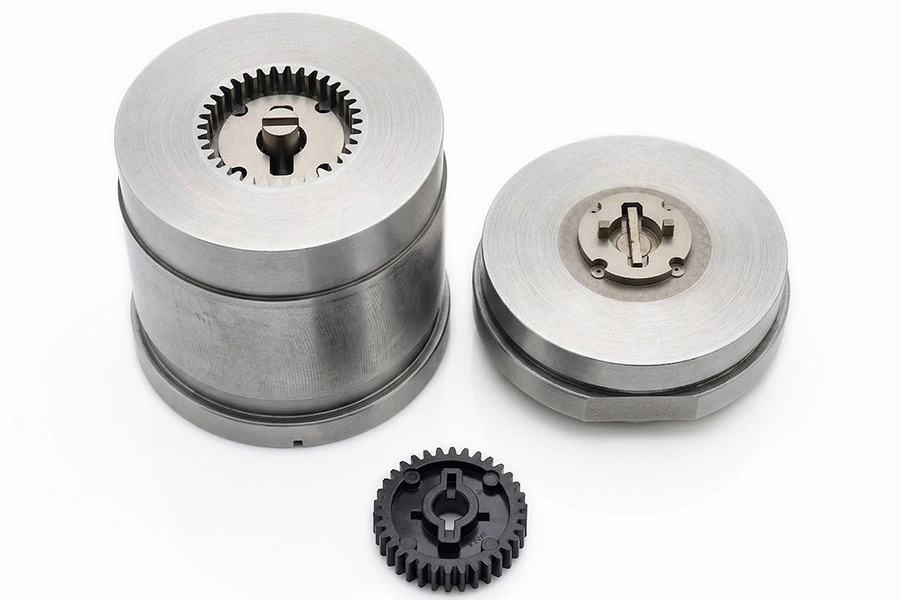
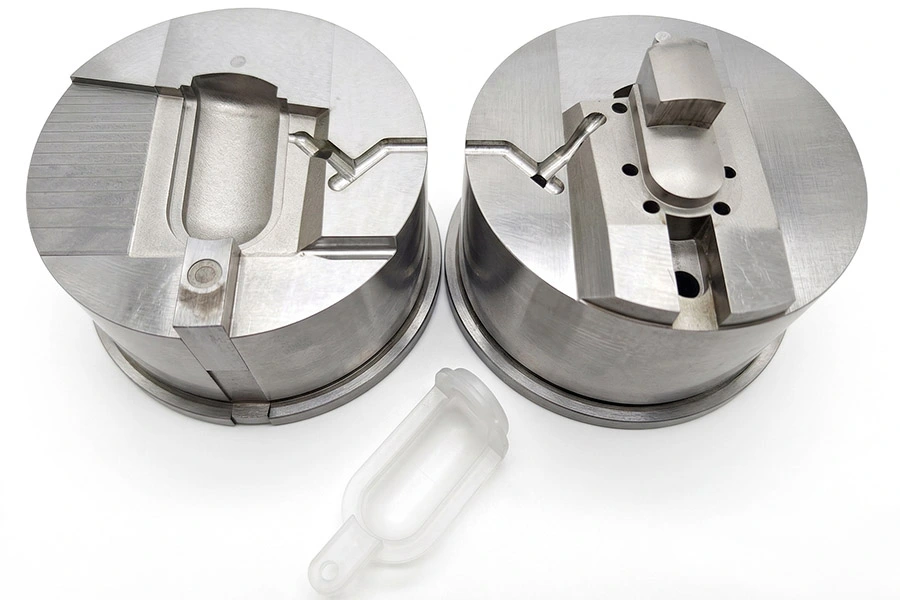
The FlexMould insert is machined using the same techniques as our regular moulds: 5-axis milling and EDM machining, both sink EDM and wire EDM. As a result, the dimensional stability, surface finish and material properties of your part are indistinguishable from production using a conventional mould. You become the full and exclusive owner of the inserts; Tumag remains the owner of the base block.
One condition remains the same as with a conventional mould: the insert can only produce what your design allows. Wall thickness, draft angle and parting line, together with any undercuts, determine whether the part comes cleanly out of the mould. Check these points before having the insert made.
When a complete mould is the better choice
We do not recommend FlexMould when your product runs at high annual volumes, requires a short cycle time, needs multiple cavities or is moulded in two components. In those cases, 2K and multi-cavity moulds are the right choice from both a technical and financial perspective, and we build those just as well. If your product grows beyond the first series, the insert is not a lost investment: the design, material choice and process parameters you validate with FlexMould are carried over to the production mould.
R&D and product validation at established companies
The system is not reserved for start-ups. R&D departments use FlexMould to produce pilot series, carry out form and fit tests, and validate the market before investing in expensive multi-cavity production moulds. After the first run, we provide a measurement report at micron level, ensuring that dimensions, shrinkage and fit are substantiated for engineering, the customer or the investor.
Development and production remain in Turnhout
To reduce mould costs, young companies often turn to low-wage countries. This brings slow communication, import costs and the risk of losing intellectual property. At Tumag, the insert, trial injection moulding and series production all remain on one site in Turnhout. Short communication lines, your IP protected under Belgian law, and you can be present for the first trial shots.
Frequently Asked Questions about FlexMoulds (FAQ)
From how many pieces does injection moulding become more interesting than 3D printing?
In practice, the tipping point is around one hundred to one hundred and fifty pieces. Above that, the scaling advantage of printing disappears due to production time and post-processing, while the unit price in injection moulding actually decreases. Tumag offers injection moulding from 50 pieces.
How many parts can one insert produce?
That depends on the chosen steel or aluminium and on the plastic material. FlexMould is suitable for series from 50 to several tens of thousands of pieces. With fibre-reinforced plastics, wear is higher, which affects the service life; we adjust the material choice of the insert accordingly.
Who owns the mould?
Tumag remains the owner of the universal base block. You are the full and exclusive owner of the product-forming inserts you have made.
Which plastics can be processed?
The base block is equipped with cooling and ejectors, allowing standard plastics (PP, PE, ABS), engineering polymers and fibre-reinforced composites to be processed. High-performance materials such as PEEK and PAI are also possible.
Is the quality lower than with a regular mould?
No. The inserts are produced using the same techniques as regular moulds: 5-axis milling, sink EDM and wire EDM. Dimensional stability and surface finish are identical to parts produced from a traditional mould.
What happens if the design changes after the first series?
In that case, only the insert is modified or replaced, not the complete mould block. This is faster and considerably cheaper, and it is exactly why this approach is suited to products that are still in development.
Can you later scale up to a complete production mould?
Yes. The validation you carry out with FlexMould — the design, material choice and process parameters — is transferred to the production mould. Tumag then builds that mould in-house, including multi-cavity and 2K.
How much does it cost to have a mould made for a small series?
A complete steel injection mould typically costs between €25,000 and €200,000. With FlexMould, you only pay for the product-forming inserts, reducing the upfront investment by 70 to 80 percent. The exact price depends on the geometry, the number of cavities and the selected steel or aluminium; send us your CAD file for a well-founded price estimate.