
Flat surfaces, tight tolerances and a fine surface finish.
At Tumag in Turnhout, we grind mould components and precision components for customers in Belgium, the Netherlands and the rest of Europe, from individual grinding work to components within a complete production process.
What is surface grinding?
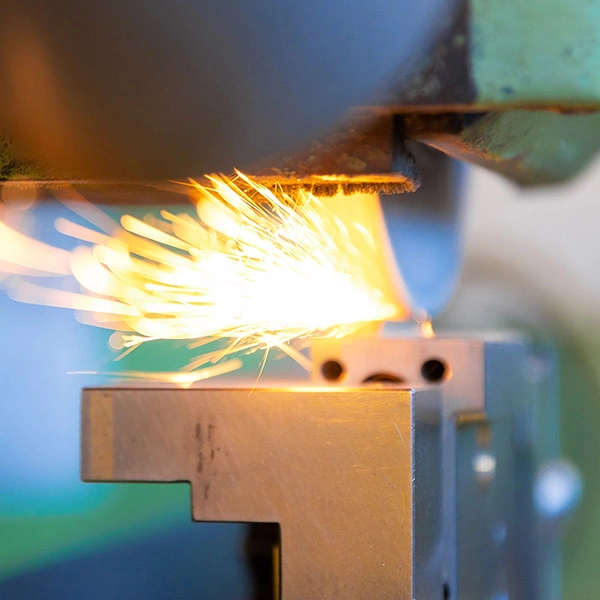
Surface grinding is an abrasive machining process in which a rotating grinding wheel with abrasive grains removes thin layers of material from a workpiece. This creates a flat surface with a fine surface quality, precise dimensions and good parallelism between both sides.
The workpiece is usually fixed on a magnetic clamping table. While the grinding wheel rotates, the table moves the workpiece in a controlled manner beneath the wheel. Material is removed in several small steps until the desired dimensions and flatness are achieved.
With surface grinding, you achieve:
- Flat surfaces
- Good parallelism
- Highly accurate dimensions
- High-quality surface finish
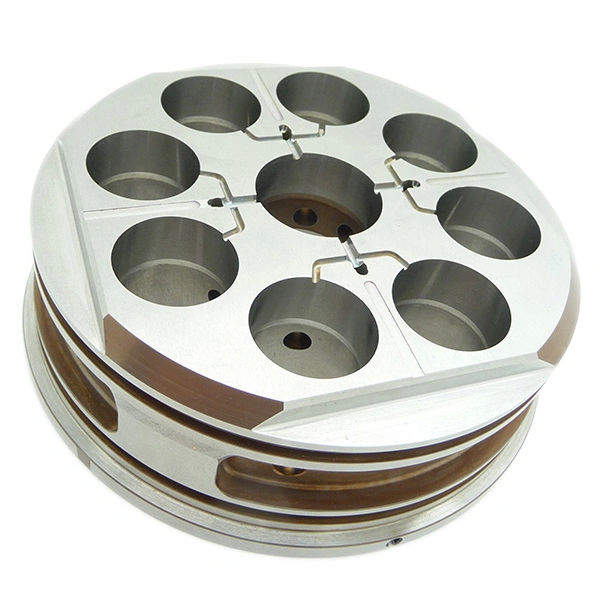
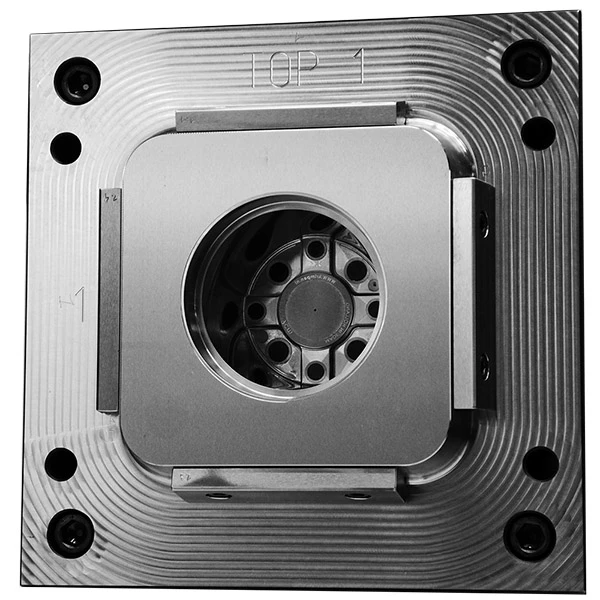
Precision surface grinding down to micron level
Vlakslijpen is een essentiële precisiebewerking voor het realiseren van vlakke oppervlakken, strakke toleranties en een hoogwaardige oppervlakteafwerking. Bij Tumag beschikken we over de machines, vakkennis en ervaring om complexe slijpopdrachten met hoge nauwkeurigheid uit te voeren.
From our workshop in the Turnhout region, we support clients across Belgium with high-quality surface grinding technology for mould components, cutting punches and other precision components.
Industrial applications of surface grinding
In many industries, surface grinding is a crucial step to ensure components meet strict quality standards.
In sectors such as aeronautics and high-tech manufacturing, surface grinding is a standard process for components that must be both lightweight, strong and extremely precise.
Some typical applications:
- Mould components and tools
- Precision machine components
- High-tech mechanical components
- Medical instruments


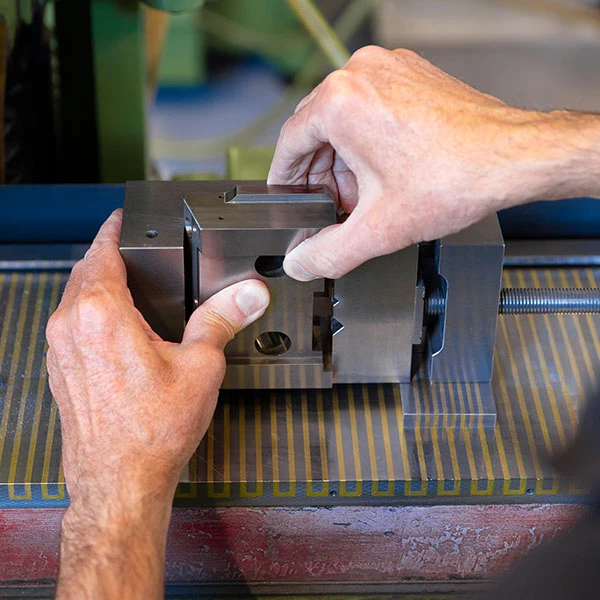
Surface grinding as a finishing operation at Tumag
At Tumag, surface grinding is rarely a stand-alone operation. In most cases, it is the finishing step that brings a mould component or precision part to its final dimensions after milling, EDM machining or hardening, and before assembly. Because we have the entire chain in-house, from engineering to quality control, the grinding work is aligned with the previous steps and we keep dimensional accuracy under control throughout the entire process.
Onze slijpers stemmen het slijpmiddel en de slijpstrategie af op het materiaal en de gevraagde tolerantie, en houden rekening met de warmteontwikkeling die de maatvoering kan beïnvloeden. Elk geslepen onderdeel controleren we daarna in onze geconditioneerde meetkamer, zodat vlakheid, parallelliteit en maatvoering aantoonbaar binnen tolerantie liggen.
This means that for the surface grinding of critical components, you have one partner for the entire process, from individual grinding work to a finished precision component.
Achievable precision and tolerances
Surface grinding is one of the most precise finishing operations in metalworking. Modern surface grinding machines can achieve tolerances of around ±0.002 mm, depending on the material and dimensions.
The surface quality can also be exceptionally fine. For precision components, a very low surface roughness can be achieved, which is essential for:
- Optimal fit of components
- Reduced friction
- Longer component lifespan
This level of accuracy makes surface grinding indispensable for critical applications in fields such as machine building, mould making and the high-tech industry.
Suitable materials for surface grinding
Surface grinding can be applied to a wide range of materials. Depending on the material, we select the appropriate grinding abrasive and the optimal grinding strategy.
Steel, stainless steel, cast iron
- Tool steel
- Structural steel
- Stainless steel (SS)
- Cast iron
Other materials
- Titanium alloys
- Ceramic materials
- Technical plastics
- Minerals
Frequently asked questions about surface grinding (FAQ)
Why choose surface grinding instead of precision milling?
Although precision milling can be very accurate, surface grinding offers several important advantages when extreme flatness and surface quality are required.
The advantages of surface grinding are: significantly finer surface finish, higher dimensional accuracy, better flatness and parallelism, and less stress in the material.
Milling is often used for faster material removal, while surface grinding is typically applied as a precise finishing operation to achieve the final dimensions and surface quality.
How precise is surface grinding?
Modern surface grinding machines can achieve tolerances of approximately ±0.002 mm, depending on the material, dimensions and geometry of the workpiece.
Which components are usually surface ground?
Typical components that are surface ground include mould components, machine guideways, precision plates, tools and wear parts.
Which materials are most suitable for surface grinding?
Materials such as tool steel, cast iron and stainless steel are highly suitable. Hard materials such as titanium and ceramics can also be ground using adapted abrasives.
When is surface grinding necessary in a production process?
Surface grinding is usually applied when other machining techniques such as milling or turning are not precise enough for the desired application.
Typical situations in which surface grinding is required: when extreme flatness or parallelism is required; when a very fine surface finish is needed; when components must fit exactly within a precision assembly; when wear or friction must be minimized.
That is why surface grinding is often used as the final precision machining step in sectors such as machine building, mould making and the high-tech industry.
What does surface grinding of metal parts cost?
The cost of surface grinding depends on several factors, such as the material, the dimensions of the workpiece, the required tolerances and the surface quality. Harder materials or very tight tolerances usually require more grinding time and specialized grinding wheels.
What is the difference between surface grinding and polishing?
Surface grinding and polishing are both machining techniques used to improve the surface of a workpiece, but they serve different functions in the production process.
In short:
Surface grinding corrects flatness and dimensional accuracy, removes material in a controlled manner, uses a grinding wheel with abrasive grains and is applied for technical precision components.
Polishing mainly improves gloss and surface quality, removes very little material, uses polishing compounds or pastes and is often applied for aesthetic or very fine finishes.
In many production processes, surface grinding is performed first to achieve the correct dimensions and flatness, after which polishing may follow to obtain an even finer surface finish.
What is the difference between surface grinding and cylindrical grinding?
In surface grinding, the workpiece lies flat on a magnetic clamping table and moves beneath a rotating grinding wheel, producing flat surfaces and parallel sides. In cylindrical grinding, the workpiece rotates around its own axis against the grinding wheel; this process is intended for cylindrical and round components.
What is the difference between surface grinding and profile grinding?
Surface grinding produces a flat, parallel surface using a rotating grinding wheel that moves across the workpiece. Profile grinding, on the other hand, creates a predefined contour or profile shape, with the form contained in the grinding wheel itself. Surface grinding is used for flat surfaces and dimensional accuracy, while profile grinding is used for complex geometries such as grooves and contours.