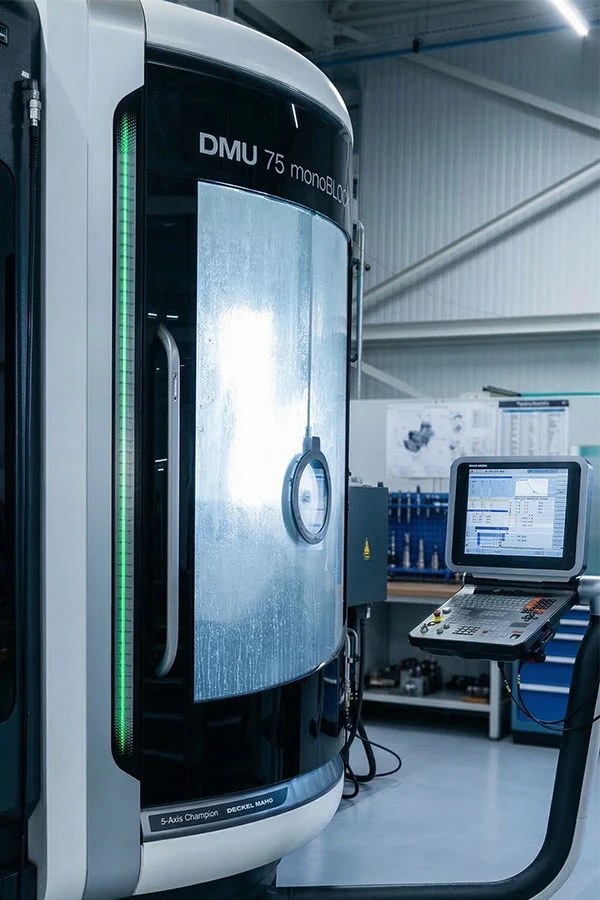
High-precision milling for the industry.
At Tumag in Turnhout, we provide high-precision CNC milling tailored for moulds, cutting dies and precision mechanical components. Using modern multi-axis CNC milling machines, we manufacture prototypes, single parts and series with maximum accuracy and consistent quality.
Our milling department supports applications in areas including mould making, the medical and high-tech industry. Thanks to our experience and advanced technology, we are able to produce complex contours, precise fits and high-quality surfaces.
CNC milling is often just one step within a broader production process. That is why we combine this technique with other operations at Tumag, such as CNC turning, wire EDM, sinker EDM and grinding. This allows us to manufacture complete components and tooling in-house, from the initial design to the finished end product.
Geavanceerd 3- en 5-assig frezen van complexe onderdelen
With modern CNC milling machines, components can be produced with high precision and repeatability. Our machines are equipped with multiple axes, allowing workpieces to be machined from different angles.
This offers important advantages:
- complex shapes in a single setup
- improved dimensional accuracy
- shorter production times
- higher surface quality
We manufacture, among others:
- precise cut-outs
- profiled surfaces
- complex cooling channels
- high-precision mating surfaces
By using advanced measuring equipment and intermediate quality inspections, we ensure that every component meets the specified tolerances.
Materialen die wij frezen: staal, aluminium en kunststoffen
Tool steel
Ideal for moulds, dies and wear-resistant components.
Stainless steel and hardened steel
For applications requiring durability, corrosion resistance and strength, such as in the medical sector.
Aluminium alloys
Widely used in prototyping, lightweight machine parts, electronics and technical housings.
Plastics (such as PEEK, POM, PA, PE, PMMA, acrylic)
Suitable for precision mechanical components, sliding elements, transparent applications and electronics.
Fiber-reinforced plastics such as carbon fibre and glass fibre
For applications where weight and strength play a major role, such as high-end car parts and racing rims.
Non-ferrous metals such as brass, copper and bronze
Excellent for electrical and precision mechanical applications.


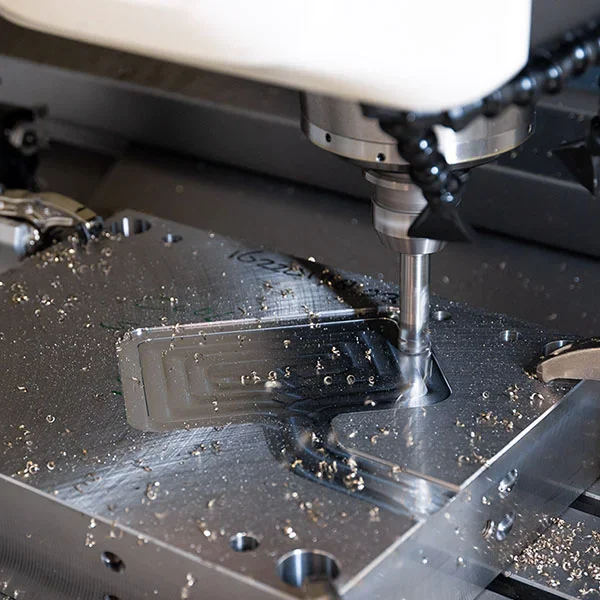
Applications of our milling services in the manufacturing industry
Our CNC milling department produces components for various sectors within the manufacturing industry.
Moulds and injection moulding components
In mould making, precision is essential. With our 3- and 5-axis milling machines, we produce complex mould geometries, cooling channels and shut-off surfaces.
Stamping and punching tools
We manufacture both single pieces and series of dies and punching components, where wear resistance, dimensional accuracy and fit are key.
Machine building and precision mechanics
For machine builders, we manufacture, among others:
- precision components
- mounting plates
- prototypes
- moving components
Maintenance and refurbishment
In addition to new production, we also provide:
- repairs of components
- refurbishment of existing components
- reconstruction of damaged parts
- re-machining of wear zones
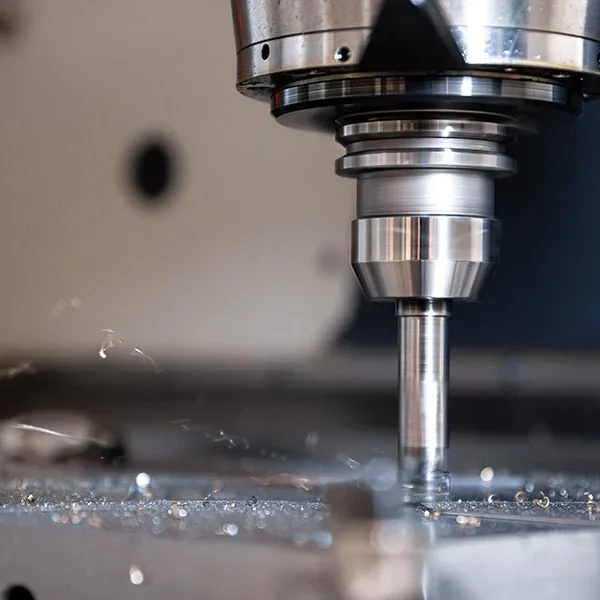
Why do customers choose Tumag as a milling partner?
Tumag combines craftsmanship with modern technology and an efficient production approach.
Modern machines
Our machine park consists of advanced 3- and 5-axis CNC milling machines, suitable for complex components.
Technical expertise
Our specialists have many years of experience in precision machining and actively contribute throughout the entire production process.
Flexible production
We produce:
- Single units and prototypes
- small series
- medium series
Strict quality control
Every step in the production process is controlled through measurement reports, internal protocols and intermediate measurements.
Complete production partner
In addition to CNC milling, we also provide complementary operations such as: HSM milling, deep hole drilling, EDM machining, grinding, assembly
This allows us to carry out complete production projects.
Milling from A to Z: From model to finished product
Whether you have a technical drawing, a 3D model or a concept idea, our engineers collaborate with you from the design phase onward.
We support you with:
- manufacturability analysis
- design optimisation
- efficient production planning
We supply, among others:
- Single units and prototypes
- small and medium series
- complex custom components
- components with high surface quality
For every assignment, we strive for an optimal balance between speed, precision and cost efficiency.
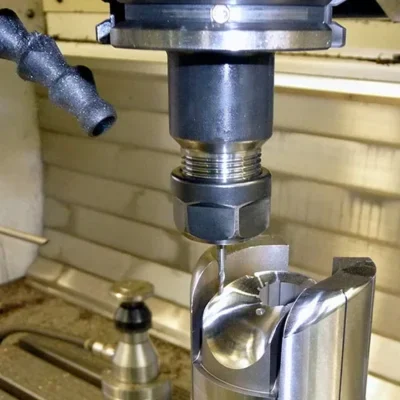
Tumag, your partner for precision milling
Are you looking for a reliable partner for custom CNC milling?
Tumag combines modern CNC technology with craftsmanship and delivers high-quality milling operations for various sectors. Feel free to contact us to discuss your project or requirements. We will be happy to assist you.
Frequently Asked Questions about CNC milling (FAQ)
What is CNC milling?
CNC milling stands for Computer Numerical Control milling. In this process, a milling machine is controlled by computer programs that precisely determine how the tool moves.
During the milling process, the cutting tool rotates at high speed while the workpiece is precisely positioned. This allows material to be removed in a controlled manner until the desired shape is achieved.
Thanks to these techniques, both simple and highly complex components can be produced with high precision.
Advantages of CNC milling:
- high dimensional accuracy
- reproducible quality
- complex geometries possible
- suitable for prototypes and series
Which materials can be CNC milled?
With CNC milling, many different materials can be machined. The most common are metals such as aluminium, steel, stainless steel (SS), brass and copper. These materials are often used in machine building and industry. In addition, plastics can also be CNC milled, for example ABS, nylon, polycarbonate and POM. These are often used for technical components or prototypes. Composite materials can also be milled using CNC machines, for example for furniture, models or specific industrial applications.
What is the difference between 3-axis and 5-axis milling?
The difference between 3-axis and 5-axis milling lies in the number of movement directions of the machine. In 3-axis milling, the cutter moves along three linear axes: X (left-right), Y (front-back) and Z (up-down). The workpiece usually remains fixed and often needs to be re-clamped to machine other sides. In 5-axis milling, two additional rotary axes are added to these three axes, allowing the cutter or the table to tilt and rotate. This enables the machine to reach the workpiece from multiple angles. As a result, more complex shapes can be produced in a single setup with higher accuracy and often a better surface finish.
When should you choose CNC milling?
CNC milling is chosen when components need to be produced with high precision and repeatability. The machine is controlled by a computer program, making complex shapes and tight tolerances possible. CNC milling is especially suitable when multiple identical parts, complex geometries or high precision are required. It is commonly used in sectors such as machine building, aerospace and medical technology. Although preparation takes time, CNC milling then enables fast, efficient and consistent production with a lower risk of human error.
Is CNC milling as precise as turning?
CNC milling and CNC turning can both achieve very high precision, but they are used for different shapes. In CNC turning, the workpiece rotates while the tool remains stationary. This makes it highly suitable for round components such as shafts or bushings and often results in very high accuracy for cylindrical shapes.
In CNC milling, the tool rotates while the workpiece usually remains fixed. This process is better suited for flat or complex shapes. The accuracy can be comparable to turning, but it depends on factors such as the machine, the tool and the programming.
In short: both processes are highly precise, but each is optimized for a different type of component.
How do you program a CNC milling machine?
Programming a CNC machine starts with creating a digital design (CAD) of the component that needs to be produced. This design is then used in a CAM program to generate toolpaths and convert them into a CNC program, usually in G-code. This program determines how the machine and the tool must move during the milling process.
At Tumag, we use Siemens NX and Fusion 360 in our CAM department to carry out this programming and preparation.
After that, the CNC program is loaded into the machine, the workpiece and tools are set up, and the machine can automatically produce the component according to the programmed instructions.