
Markets
Cleanly manufactured, ready for final cleaning
Machines in the semiconductor industry are built from precisely manufactured parts, on which every dust particle is a risk to proper operation. Tumag produces these precision components for machine builders and their suppliers in this sector.
At our plant in Turnhout, we combine CNC machining, EDM and grinding, together with measurement in our climate-controlled metrology room. Every part is cleanly manufactured and packed, ready for final cleaning by the customer or their cleaning partner.
What the semiconductor industry expects from a supplier
Parts for the semiconductor industry end up in machines for lithography, deposition, wafer handling and inspection, among others.
On top of tight tolerances and high surface quality requirements comes cleanliness. A fingerprint or a leftover drop of cutting fluid can outgas in a vacuum and disrupt the machine's operation. In this sector, a clean surface is therefore not an afterthought, but a requirement that runs through the entire production process.
Precision components for the semiconductor supply chain
Tumag produces precision mechanical parts to the customer's specification. We work as a supplier in the chain: our customers are machine builders who further process, clean and assemble the parts. For every order, we follow the specification down to the last detail:
- dimensional, form and position tolerances, with a measurement report from our climate-controlled metrology room;
- the material and its material certificate;
- the required cleanliness grade and the working method that goes with it;
- packaging and labelling requirements.
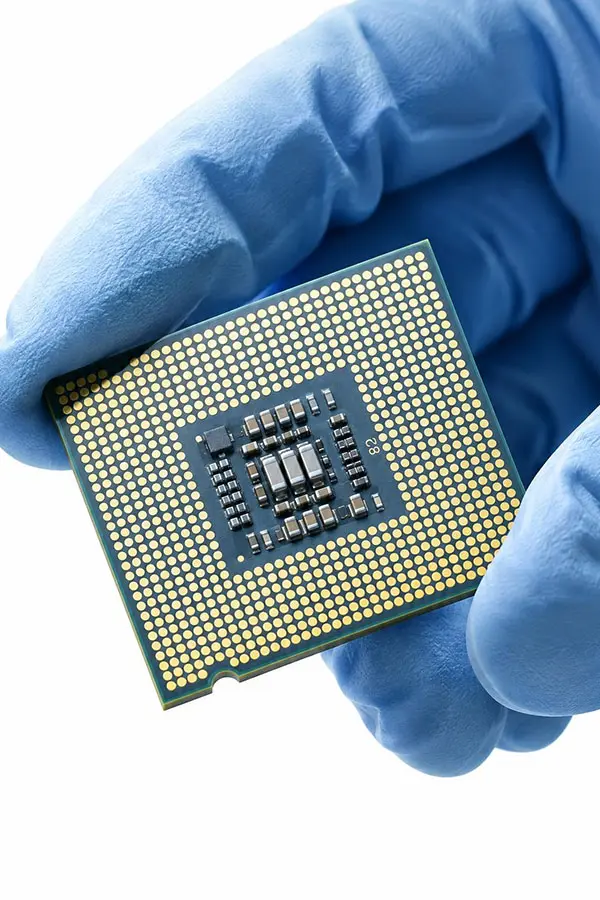
Moulds and cutting dies for the semiconductor industry
Tooling for engineering plastic parts
For engineering plastic parts such as housings, carriers and insulating components, we design and build injection moulds at our own plant in Turnhout. Engineering, mould making and adjustments all take place under one roof, so design changes are implemented quickly. For prototypes and validation runs, a FlexMould with interchangeable inserts keeps start-up costs down.
Punching and cutting of thin materials
For punching and cutting thin metals, films and technical materials, we build custom cutting dies. If required, we also take care of all after-sales service: after maintenance, regrinding or a repair, your die is quickly back in production.
Ready for cleaning: clean production for the semiconductor supply chain
Parts for vacuum applications receive their final cleaning at the customer's site or from a specialised cleaning partner. We deliver our parts “ready for cleaning”: free of dried cutting fluid, stains and embedded particles. Our production process is built around that.
Clean machining
After machining, we rinse off cutting fluids immediately so they cannot dry and bond to the surface. Parts with a cleanliness requirement are only handled with gloves, and we machine them with tooling reserved for that purpose.
Packaging and traceability
After final inspection, we pack the parts cleanly and sealed, following our customer's guidelines. A label on every package ensures traceability. The customer or their cleaning partner can then process the part straight away.
What does “ready for cleaning” mean?
A part is ready for cleaning when it has been produced and packed in such a way that final cleaning can reach the required cleanliness level. In practice, this means no dried cutting fluid, no fingerprints, no embedded particles and clean packaging. Tumag produces parts according to this principle; final cleaning is carried out by the customer or their cleaning partner.
What does Grade 2 mean?
Grade 2 is a cleanliness grade from ASML's GSA standards that specifies how many particles and how much molecular contamination may remain on the surface of a part. The grades run from 1 to 5, with 1 being the strictest. Grade 2 is typically required for parts used in ultra-high vacuum. Cleaning to Grade 2 and its verification, including UV light inspection and residual gas analysis, take place after production at the customer or their cleaning partner.
Techniques and materials
Semiconductor parts often combine several machining operations. We agree with our customer on which techniques to use.
We machine materials including stainless steel, Inconel, aluminium, titanium, copper alloys and engineering plastics such as PEEK and POM. The material always follows the drawing or specification: we never substitute an alloy without the customer's approval.
A supplier close to the Brainport region
Tumag is based in Turnhout, close to the Brainport region around Eindhoven. Short lines of communication make it easier to align drawings, changes and measurement results quickly, and keep transport distances short. Engineering, production and quality control are all done in-house, so that all documentation and technical data stay within a controlled environment.
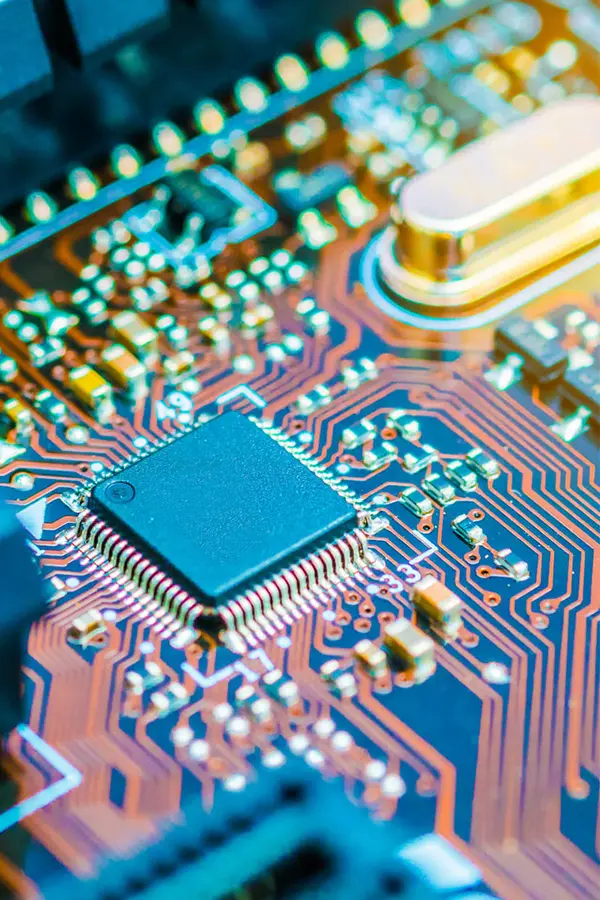
Frequently asked questions about parts for the semiconductor industry (FAQ)
What are semiconductors?
A semiconductor is a material that conducts electricity better than an insulator such as glass, but less well than a conductor such as copper. By adding small amounts of other elements (doping), this conductivity can be precisely controlled. Silicon is the best-known semiconductor material. Semiconductors are used to make transistors, diodes and chips, the basis of almost all electronics: from smartphones and cars to medical equipment.
How are semiconductors made?
Chips are made on wafers: thin, polished discs of pure silicon. In a cleanroom, patterns are applied to them layer by layer. A lithography machine projects the design with light onto a light-sensitive layer. The pattern is then etched, new layers are deposited and the material is doped. This cycle is repeated for each layer, and a modern chip has dozens of them. Finally, the wafers are tested, diced into individual chips and packaged.
The machines for all these steps are made up of thousands of precision components. Tumag produces this type of component for machine builders and their suppliers in the semiconductor supply chain.
What is the difference between a cleanliness grade and a cleanroom class?
A cleanroom class, such as under ISO 14644, specifies how many particles may be suspended in the air of a room.
The cleanliness grade, such as Grade 2, concerns the part itself: the amount of particles and molecular contamination that may remain on its surface.
A cleanroom helps keep a part clean, but does not make it clean.
How is the cleanliness of a part checked?
Inspection under UV-A light and bright white light in a darkened room makes grease residues and particles visible. For vacuum applications, residual gas analysis (RGA) measures which substances a part releases in a vacuum.