
Your Tumag Flexmould in 6 Steps
Thanks to Tumag, you save valuable time and budget in the crucial phase from prototype to small-series production. With an affordable mould for small series, you can make the transition to injection-moulded plastic faster, more flexibly and more affordably, without having to invest immediately in a complete, exclusive mould. This allows you to retain the freedom to iterate and optimise, while avoiding the high start-up costs and long lead times of traditional tooling.
In this guide, you will discover how to move from idea to a first small production run with your FlexMould, with one tooling partner in Turnhout offering engineering, production, quality control, and trial injection moulding under one roof. You can also explore our approach to engineering and co-engineering, mould making, small-series injection moulding, and quality control.
Step 1: Make Your Idea Production-Ready With Co-Engineering
A strong concept is not yet an injection-moldable product. In this phase, we review functions, wall thicknesses, draft angles, tolerances, and material choice together. This way, you avoid late design changes derailing your timeline or budget.
Tumag helps you start your FlexMould process correctly from the outset through engineering, with a focus on manufacturability and repeatability. Would you like to review those points yourself before the first meeting? We explain the seven rules of thumb around wall thickness, release and parting line separately. Tumag then helps you start the process correctly through engineering, with a focus on manufacturability and repeatability.
Step 2: Choose a Flexmould Instead of a Full Mold
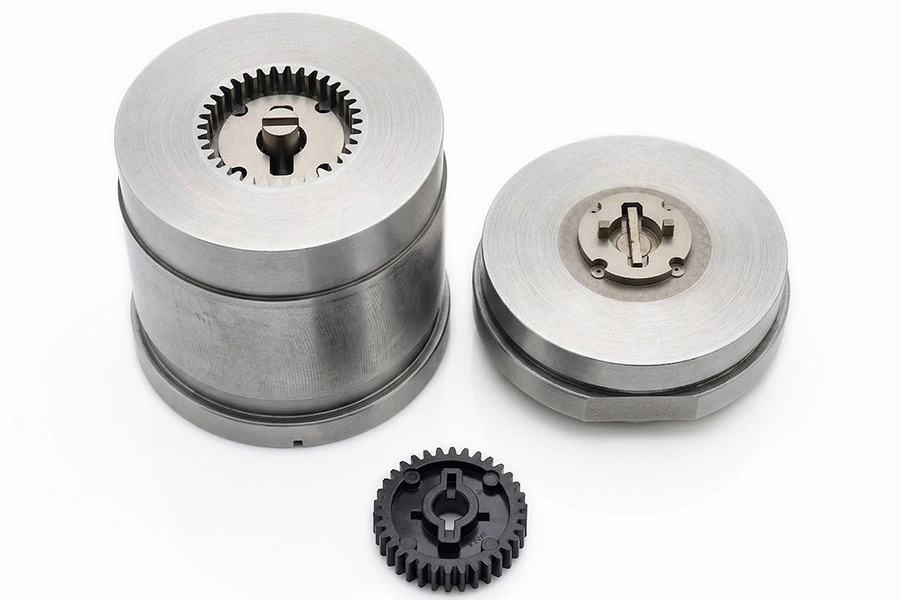
A traditional mold usually only makes sense at high volumes. The flexmould concept works differently: Tumag manages the universal base block, and you invest in the product-forming inserts. This keeps the entry barrier low and makes iteration feasible.
Curious how this compares to a full steel mould? On our page, you can read what a modular mould costs, how long the lead time is and from which quantities it becomes cost-effective.
Step 3: Design Your Insert for Your Flexmould
Your product is translated into an insert that fits the modular system. This is also the time to consider variants: a minor geometry change doesn't mean starting from scratch, but simply an adjusted insert.
For the technical process and design choices, you can rely on our engineering approach.
Step 4: Produce the Insert with Belgian Precision
Once the design has been finalised, we manufacture the inserts with high-end tooling in Turnhout. Thanks to short communication lines, you can move faster, especially when timing or confidentiality matters.
Because we manage all stages of high-precision production in-house, we can respond with exceptional flexibility to your specific needs.
Step 5: Sampling and Small Series Production with Flexmould Molding
Now it becomes tangible: we place the insert in the flexmould base and start sampling. Your small series follows, tailored for validation, pre-sales, or a first market introduction. This is flexmould molding the way startups need: fast, controlled, and without over-investment.
Plan your process via small-series injection moulding and trial injection moulding.
Step 6: Measure, Evaluate, and Build Your Flexmould Review
After the first run comes the technical evaluation: dimensions, shrinkage, fit, surface quality, and process stability. With measurement reports and feedback, you build a well-founded FlexMould review for stakeholders or investors. If needed, you can iterate with an adjusted insert while keeping the base unchanged.
See how we measure and report through our quality control.
Well-Founded Choices, Faster Iterations, and Less Tooling Risk
Silicone moulds are useful for design studies and a few dozen parts, but for functional components in engineering plastics, injection moulding is the step towards consistent quality. The modular principle of your flexmould provides a pragmatic lever here: you limit fixed costs, speed up iterations and keep production closer to home.
Please note: if your product requires very high volumes, extremely short cycle times, or multi-cavity capabilities, we will discuss in good time whether a conventional mould would be the better next step later on.
From Idea to First Series, Without Unnecessary Investments
With Tumag, you choose one integrated partner: from co-engineering and injection moulding to metrology. Would you like to assess whether a FlexMould is suitable for your part, the desired plastic, and the intended volumes? Then contact us and send us your CAD file, sketch, or prototype for a well-founded and professional assessment.